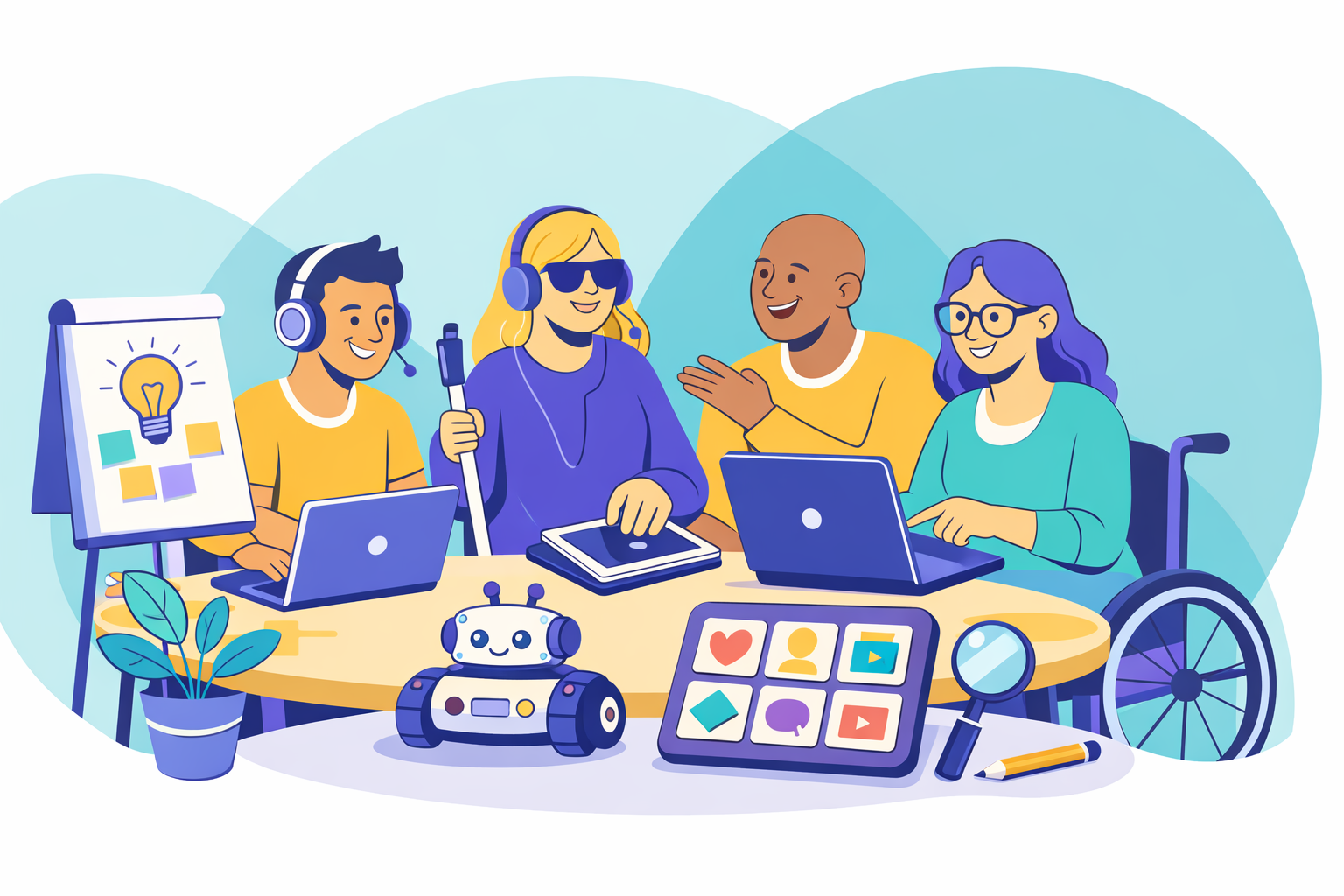
Inclusive education represents one of the main challenges facing contemporary education systems worldwide, particularly in contexts of increasing learner diversity and the recognition of education as a fundamental human right. Despite normative and discursive advances, structural, methodological, and attitudinal barriers persist, limiting the full participation and learning of persons with disabilities and individuals with specific educational needs, both in compulsory education and in adult education and subsequent learning pathways.
Universal Design for Learning (UDL) as a Theoretical Approach
Within this context, Universal Design for Learning (UDL) is framed as a theoretical approach that seeks to rethink educational processes through flexibility, incorporating pedagogical reflection as a key element for responding to the diversity present in classrooms at all levels of the education system. From this perspective, UDL enables the coherent articulation of curriculum, teaching strategies, and learners’ individual characteristics within the teaching and learning process (Castellanos Vega & Torres Reyes, 2025) (1). Nevertheless, its effective implementation in real contexts remains a challenge, particularly in diverse and decentralised settings.
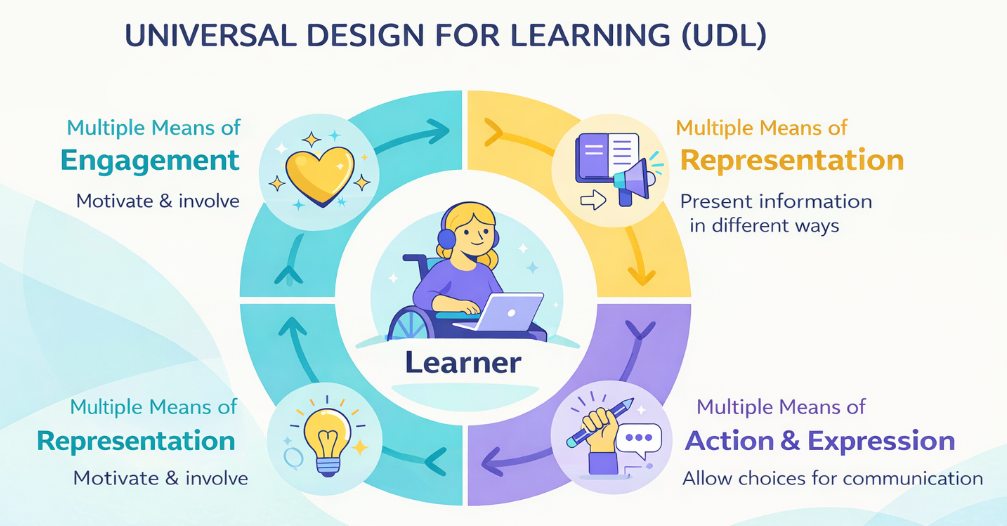
The aim of this article is to analyse two nationwide educational intervention projects and one European-level awareness-raising and cultural change project carried out by COCEMFE, all focused on the educational support of individuals with specific educational needs. Based on these experiences, the article seeks to identify relevant contributions of UDL to the development of more inclusive educational practices and to reflect on the factors that foster their impact and sustainability.
Overview of the Analysed Projects
During the 2024–2025 academic year, COCEMFE ran two nationwide projects were implemented with the aim of strengthening the autonomy, learning, and participation of persons with disabilities across different regions: Educational support for adults with specific educational needs (SEN) and Actions to promote the use of ICT among students with SEN arising from disability. In addition, since 2023, the Erasmus+ project Design2Freedom has been coordinated, aligned with the commitment to promoting inclusive and high-quality higher education through awareness-raising and the promotion of a culture of person-centred inclusive design in higher education.
Based on this conceptual and contextual framework, the main results derived from the analysed experiences are presented below.
Project 1: Educational Support for Adults with SEN
On the one hand, the project Educational support for adults with specific educational needs was implemented in 11 centres nationwide. The programme integrated vocational guidance, accessible digital literacy, social skills development, and the promotion of independent living, incorporating a gender perspective and the principles of UDL in a cross-cutting manner. The results significantly exceeded the initially established indicators, leading to the implementation of innovative pedagogical experiences. These outcomes indicate that flexible and person-centred approaches increase engagement and enhance the effectiveness of learning initiatives.
Project 2: ICT Actions for Students with SEN Arising from Disability
On the other hand, the project Actions to promote the use of ICT among students with SEN arising from disability fostered the use of communication devices and boards, adapted tablets, educational robotics, and experiential learning activities. The project expanded learning opportunities for 277 students with special educational needs and included targeted support for teachers and families to ensure the continuity of support measures. These results reinforce the idea that inclusive education requires systemic interventions sustained through collaborative networks, and that cooperation between the associative movement, teaching teams, and families multiplies the impact of interventions, facilitates their continuity, and contributes to the transformation of educational practices towards more accessible and equitable models.
Project 3: Design2Freedom (Higher Education, Awareness-Raising, and Cultural Change)
Finally, the Design2Freedom project is grounded in the recognition of higher education as a universal right, as set out in the Universal Declaration of Human Rights (UN, 1948), as well as in the premise that ensuring access, retention, and completion of university studies under equal conditions constitutes a responsibility of States, particularly with regard to groups in situations of greater vulnerability, including persons with disabilities (Prieto-Jiménez et al., 2026) (2). The project has produced four intellectual outputs (Experience Map, Toolbox, MOOC Course, and Good Practices Guide), conceived as resources to promote the inclusion of persons with disabilities in higher education. In line with the literature, this initiative highlights the importance of awareness-raising and cultural change processes as key elements for consolidating inclusive practices, acting as a complementary initiative to educational interventions and fostering a shared understanding of accessibility, diversity, and inclusion in university teaching and design processes.
Overall Findings
Overall, the results obtained from the three analysed projects reinforce the potential of UDL as a reference framework for the development of inclusive educational practices in diverse contexts. As noted by Castellanos Vega and Torres Reyes (2025), the capacity of UDL to articulate curriculum, methodologies, and learner diversity is reflected in the range of actions implemented and the breadth of profiles addressed.
In conclusion, the application of UDL, combined with the use of accessible technologies and collaborative models involving educational and social stakeholders, makes a significant contribution to the creation of more inclusive and equitable learning environments. Thus, COCEMFE reaffirms the need to continue promoting initiatives that guarantee the right to inclusive education under equal opportunities and enable all people to develop their life and educational projects with the necessary support
(1) Castellanos Vega, R., & Torres Reyes, A. M. (2025). Personalising higher education: REAPSES, UDL and technology. In L. Vega Caro & A. Vico Bosch (Eds.), Transforming education: Teacher training in ICT for inclusive and emotional learning (pp.
293–312). ISBN 979-13-7006-131-9.
(2) Prieto-Jiménez, E., Perea Rodríguez, M. J., Parra Gómez, M. L., & Domínguez-Fernández, G. (2025). Higher education as a human right: A diagnosis of university inclusion of groups in situations of vulnerability in Ibero-America.